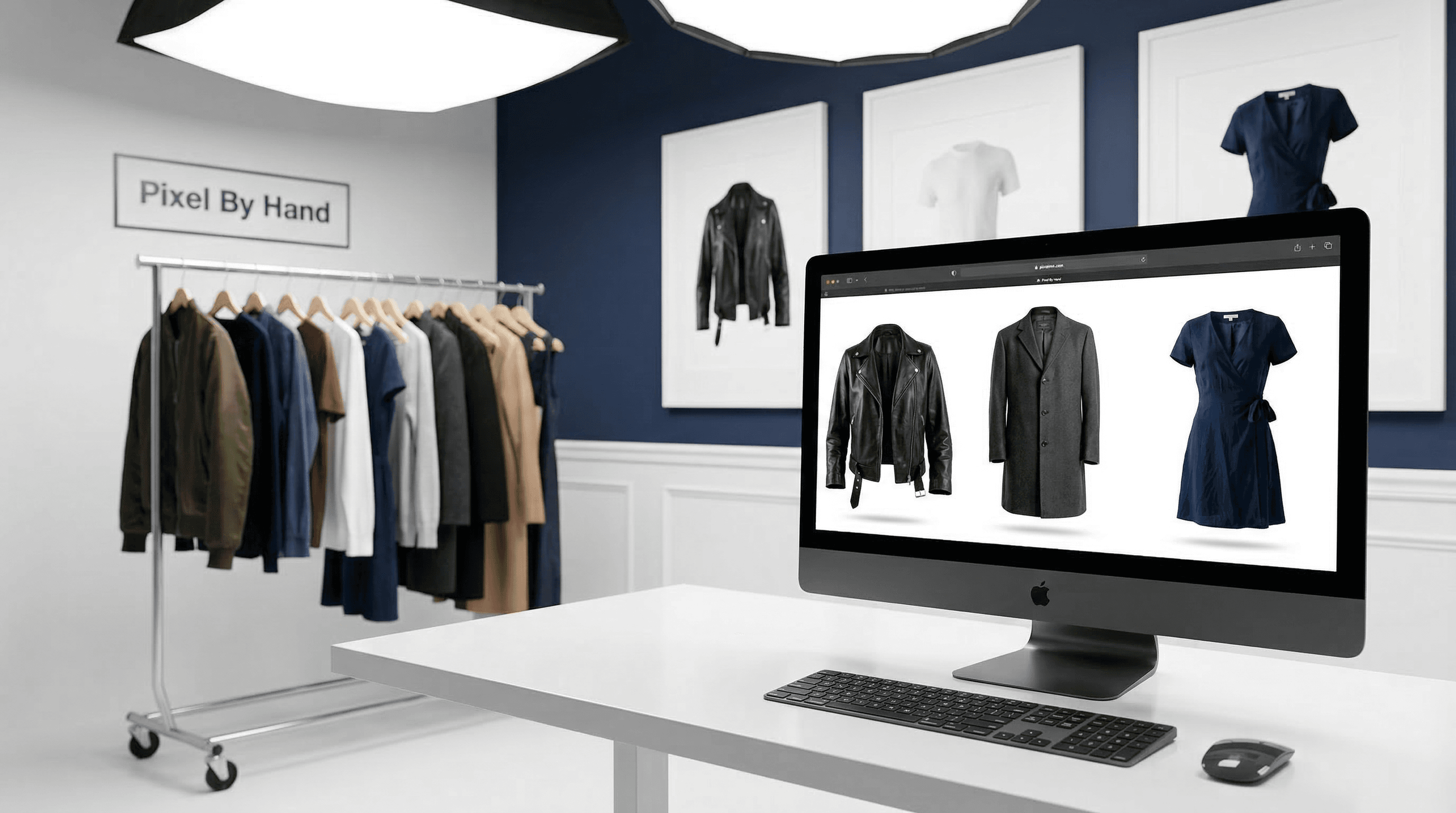
Your product images are the single most important conversion factor on your eCommerce site. According to Forbes research, 50% of online consumers rank large, high-quality product photos as more important than descriptions, specifications, or even reviews.
Yet most online retailers still treat post-production as an afterthought — burning hours on repetitive edits, struggling with inconsistent quality, and delaying product launches because the images aren't ready.
There is a better way. Outsourcing product photo editing to a specialist service lets you get professional-quality images faster, more consistently, and often at a lower total cost than doing it yourself. This guide covers everything you need to know — from why outsourcing makes sense, to how to evaluate providers, to the questions you should ask before signing up.
Table of Contents
- Why Product Photo Quality Matters More Than You Think
- What Does Product Photo Editing Actually Involve?
- In-House vs. Outsourced Editing: An Honest Comparison
- Seven Reasons to Outsource Product Photo Editing
- How to Choose the Right Photo Editing Partner
- The Questions You Must Ask Before Outsourcing
- Getting Started: Your First Outsourced Edit
- FAQ
Why Product Photo Quality Matters More Than You Think
Online shoppers cannot touch, hold, or try on your products. Your images are doing all of that heavy lifting. A crisp, well-lit, accurately coloured product photo is often the difference between a click on "Add to Basket" and a bounce to a competitor.
Consider the numbers: there are over 9.1 million online retailers worldwide, with 2.5 million in the United States alone. In a market that competitive, product photography is not a nice-to-have — it is a core part of your brand and sales strategy.
Poor images do not just look unprofessional. They actively cost you money through lower conversion rates, higher return rates (customers receive something that does not match what they saw), and weaker brand perception.
The standard your images must meet is non-negotiable:
- Sharp focus — blurry photos lose customers instantly
- Accurate colour — what they see must match what they receive
- Clean, consistent backgrounds — clutter distracts from the product
- Correct cropping and alignment — products should fill the frame properly
- Visible details — buttons, stitching, textures, labels all need to be clear
- High resolution — pixelated images look cheap
If even one of these falls short, it impacts your conversion rate. The question is not whether to invest in quality editing — it is how.
What Does Product Photo Editing Actually Involve?
Before deciding whether to handle editing in-house or outsource it, it helps to understand what the work actually entails. There is an important distinction between editing and retouching, though the terms are often used interchangeably.
Basic Editing (Mechanical)
These are the foundational tasks that every product image requires:
- Background removal and replacement
- Clipping paths
- Cropping, alignment, and margin setting
- Image resizing and compression
- Colour correction and white balance
- File format conversion (PNG, JPG, WebP)
- Aspect ratio standardisation
Advanced Retouching (Creative)
This is the manipulation of the product's appearance within the image:
- Removing dust, scuffs, scratches, and imperfections
- Wrinkle and crease removal on clothing
- Ghost mannequin / invisible mannequin compositing
- Shadow creation and adjustment
- Skin retouching for model shots
- Glare and reflection removal
- Colour enhancement to make products "pop"
Style Templates
A professional editing service will work from your style template — the overall look, feel, and consistency standard for your product images. This covers background colour, margin sizes, shadow style, colour treatment, and image dimensions. If you do not have one yet, a good partner will help you create one.
Getting this right is essential. Consistency across every image on your site builds trust and reinforces your brand. Skip this step at your peril.
In-House vs. Outsourced Editing: An Honest Comparison
There are two ways to get your product photos edited. Both have genuine advantages and drawbacks.
In-House Editing
How it works: A member of your team (or a dedicated hire) edits all product images using software like Adobe Photoshop or Lightroom.
| Advantages | Disadvantages |
|---|---|
| Full control over the process | Requires investment in software, hardware, and training |
| Potentially faster for small, ad-hoc edits | Quality varies with individual skill level |
| Direct communication with the editor | Repetitive work leads to burnout and high staff turnover |
| No external dependencies | Difficult to scale during peak seasons |
| Editors get pulled into other tasks, creating bottlenecks | |
| Recruitment and training costs add up over time |
Outsourced Editing
How it works: You send raw images to a specialist editing company. They edit to your specifications and return the finished files, typically within 24 hours.
| Advantages | Disadvantages |
|---|---|
| Access to professional expertise without hiring | Less direct control over the minute-by-minute process |
| Scales instantly — 10 images or 10,000 | Requires clear communication of your requirements |
| Consistent quality through established QC processes | Turnaround depends on the provider (choose carefully) |
| No recruitment, training, or equipment costs | Potential communication barriers with some offshore providers |
| You only pay when you need the service | |
| Frees your team to focus on growth activities |
The honest truth? Most photographers and studios are already outsourcing their editing. A photographer's skill is in capturing the shot — not spending hours at a desk removing backgrounds. If the professionals who take the photos are outsourcing the editing, that should tell you something.
Seven Reasons to Outsource Product Photo Editing
1. Seasonal Demand Makes In-House Staffing Nearly Impossible
eCommerce product photography is inherently seasonal. Fashion retailers see dramatic swings month to month as trends and seasons change. One week you need 50 images edited, the next you need 500.
Maintaining the right number of in-house editors for this is virtually impossible. They are either sitting idle or drowning in work. When you outsource, you pay for what you need, when you need it. Peak season? Your provider scales with you. Quiet period? You are not paying salaries for people with nothing to do.
2. Bottlenecks Kill Sales
When image editing becomes a bottleneck — and with fluctuating volumes, it will — there is a direct cost. A delay of even a few days between a photoshoot and images going live on your site means lost sales and falling behind competitors who move faster.
A professional editing service eliminates this bottleneck entirely. Standard turnaround should be 24 hours or less. At Pixel by Hand, we operate across three shifts, 24/7 — upload before 6pm and your edited images are back by 10am the next morning. That is faster than most in-house teams can manage.
3. Consistency Builds Your Brand
Every time an in-house editor leaves and a new one starts, your image consistency takes a hit. Even subtle differences in colour treatment, cropping, or shadow style can weaken your brand's visual identity.
An outsourcing partner maintains consistency across thousands of images because they work from your style template with established quality control processes. Every image looks like it belongs on the same site.
4. Repetitive Work Causes Burnout
Let's be honest: most product photo editing is repetitive. Background removal, clipping paths, resizing — these tasks are essential but monotonous. While some retouching work is creatively stimulating, the bulk of it is a grind.
In-house editors doing this work day after day burn out. Quality drops. Turnover increases. Recruitment and training costs pile up. An outsourcing partner has the structure, team rotation, and specialisation to handle this volume without the quality dip.
5. Specialist Experience Produces Better Results
Product photo retouching requires genuine artistic skill. It is not the same as basic cropping or resizing. Knowing how to handle skin tones on a model shoot, create natural-looking shadows, or execute a flawless ghost mannequin composite takes years of practice.
A specialist eCommerce editing service has editors who do this work every day across hundreds of brands. They have seen every product category, every lighting challenge, and every marketplace requirement. That depth of experience translates directly into better results for your images.
6. You Free Up Time for Revenue-Generating Activities
Every hour your team spends on image editing is an hour not spent on marketing, product development, customer acquisition, or strategy. The opportunity cost is real.
Outsourcing shifts that time back to activities that directly grow your business. It is one of the highest-ROI decisions an eCommerce business can make.
7. It Costs Less Than You Think
When you factor in the true cost of in-house editing — software licences, hardware, recruitment, training, employee benefits, management overhead, and the cost of inconsistency and delays — outsourcing is often cheaper.
You eliminate fixed costs entirely. You pay per image, only when you need the service. And bulk discounts mean the per-image cost drops as your volume increases.
Ready to see the difference? Send us your images for a free sample edit — no commitment, no card required. We will show you exactly what we can do.
How to Choose the Right Photo Editing Partner
The worst mistake you can make is choosing the cheapest provider. A service quoting 5p per image that delivers late, produces inconsistent quality, and requires hours of your time chasing corrections actually costs you far more than a professional service at a fair price.
Here is what to look for:
Specialisation
Find a provider that specialises in eCommerce product photo editing specifically. Generic photo editing services that handle weddings, portraits, real estate, and products will not have the depth of expertise you need.
At Pixel by Hand, product image editing for eCommerce is all we do. We have worked with over 380 clients across 10+ years. It is our sole focus.
Portfolio and Track Record
Ask to see before-and-after examples. Look for consistency across different product types. Check client reviews and ask how long their clients have been with them — long-term client relationships are a strong signal of reliability.
Tools and Technology
Ask what software they use. Professional services use industry-standard tools like Adobe Photoshop and Lightroom. Also ask about their image transfer system — it should be secure, fast, and simple to use. Avoid providers where you need to involve third-party file-sharing tools.
Turnaround Time
For eCommerce, speed matters. Your provider should be able to deliver edited images within 24-48 hours as standard, with the ability to handle rush orders when needed. Ask for specific turnaround commitments and what happens when deadlines are not met.
Scalability
Can they handle 50 images one week and 5,000 the next without dropping quality or missing deadlines? Spikes in volume should not affect delivery times or image quality. This is where many smaller or newer providers fall short.
Communication
This is often underestimated but critically important. You need to be able to reach a real person quickly when you have questions or urgent requests. Ask about their communication channels, response times, and whether you will have a dedicated point of contact.
Poor communication may not seem like a big deal when you are evaluating providers, but it causes enormous frustration and wasted time once work begins.
Ethical Practices
The eCommerce and fashion industries have faced scrutiny over exploitation in outsourced work. Ask about employee working conditions, retention rates, and fair pay practices. You need your editing partner's ethics to align with your brand values.
The Questions You Must Ask Before Outsourcing
Before committing to a provider — or even deciding whether to outsource at all — work through these questions:
| Question | What It Tells You |
|---|---|
| How many images do we need edited per month/year? | Whether your volume justifies in-house or demands outsourcing |
| What is our budget for editing? | Whether in-house costs (software, salaries, equipment) or per-image outsourcing is more cost-effective |
| How seasonal is our product photography? | High seasonality strongly favours outsourcing |
| How quickly do images need to go live after a shoot? | If speed is critical, outsourcing typically wins |
| Does our team have the specialist editing skills required? | Be honest — Photoshop basics are not the same as professional retouching |
| Is this an ongoing need or a one-off project? | Ongoing needs almost always benefit from a dedicated outsourcing partner |
| What level of control do we need over the process? | Outsourcing requires trust, but a good provider collaborates closely on your style guide |
| What is the true cost of delays to our business? | If slow editing delays product launches, the cost of not outsourcing may be far higher |
Getting Started: Your First Outsourced Edit
If you have decided that outsourcing is right for your business, here is how to make the transition smooth:
-
Prepare your style template. Document your requirements: background colour, image dimensions, margin sizes, shadow style, colour treatment standards, and any marketplace-specific requirements (Amazon, Shopify, etc.). If you are not sure, your editing partner should help you create one.
-
Start with a trial batch. Never commit to a large volume before testing. Send a small selection of images and evaluate the results against your standards.
-
Give clear, specific feedback. The first batch is a calibration exercise. Be precise about what you want changed — "make it brighter" is less useful than "increase exposure by 0.5 stops and warm the white balance slightly."
-
Establish your workflow. Agree on how images will be sent and received, turnaround times, revision processes, and who your point of contact is.
-
Scale gradually. Once you are confident in the quality and consistency, ramp up your volume.
Start your free trial with Pixel by Hand. Send us a selection of your current product images and we will return professionally edited samples — completely free, no obligation. Get started here.
FAQ
How much does it cost to outsource product photo editing?
Pricing varies by provider and the complexity of edits required. Basic background removal is less expensive than detailed retouching. Most professional services offer per-image pricing, with discounts for higher volumes. At Pixel by Hand, we provide a custom quote based on your specific requirements — get in touch for a free quote.
What is the typical turnaround time for outsourced editing?
A reputable service should deliver within 24-48 hours for standard orders. At Pixel by Hand, we offer overnight turnaround as standard — upload by 6pm and receive your edited images by 10am the next morning. Rush orders can be accommodated with advance notice.
Will outsourcing mean I lose control over how my images look?
No. A good editing partner works from your style template and collaborates closely with you to understand your brand's visual identity. You review the output, provide feedback, and approve the final results. After the initial calibration period, most clients find that outsourced editing is actually more consistent than in-house work.
Is outsourcing suitable for small businesses with low image volumes?
Absolutely. In fact, small businesses often benefit the most because they avoid the fixed costs of software, equipment, and dedicated staff. You pay only for what you need, when you need it — making it accessible regardless of your size.
How do I send my images securely?
Professional editing services provide a secure image transfer system. At Pixel by Hand, we use our own secure upload platform — there is no need for third-party file-sharing tools. Your images are handled with full confidentiality.
What types of editing can be outsourced?
Virtually everything: background removal, clipping paths, colour correction, cropping and resizing, ghost mannequin compositing, shadow creation, skin retouching, dust and imperfection removal, image compression, and format conversion. If you need it done to a product image, a specialist service can handle it.
About Pixel by Hand
We are a specialist product photo editing service with over 10 years of experience and 380+ eCommerce clients worldwide. Product image editing is all we do — and we are very good at it.
Every client gets a dedicated point of contact, consistent quality through our multi-stage QC process, and turnaround times that keep your product launches on schedule.
Ready to see what we can do with your product images? Start your free trial — send us a selection of your current images and we will show you the difference professional editing makes. No cost, no commitment.