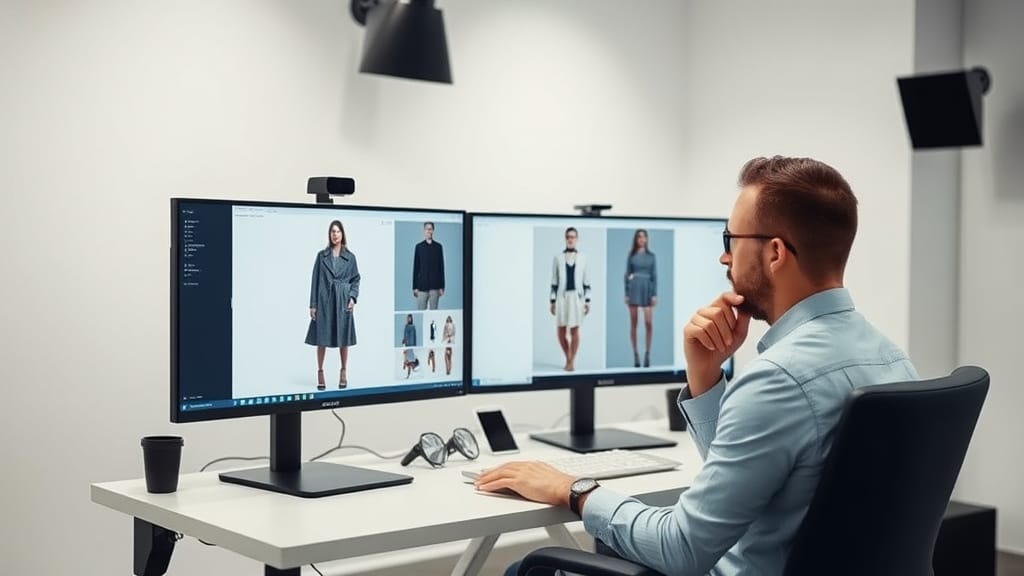
Can AI Replace Product Photo Retouching? What the Data Says
AI product photo retouching tools have exploded in capability over the past two years. Generative fill, one-click background removal, automated shadow creation — tasks that took a skilled editor 15 minutes can now happen in seconds. The question every eCommerce business is asking: can AI replace professional retouching entirely?
We wanted to answer that question with data, not opinion. At Pixel By Hand, we've spent over 10 years editing product images for 380+ eCommerce clients. We've tested every major AI tool on the market. This article breaks down exactly what AI can do today, where it still falls short, and what the research says about the business impact of each approach.
The short answer: AI is a powerful tool, but the gap between "good enough" and "excellent" product imagery is where conversions are won and lost — and that gap still requires human expertise.
Table of Contents
- The Current State of AI Retouching (2026)
- What AI Can Now Do Well
- What AI Still Cannot Do Reliably
- The AI Capability Matrix
- The Data: How Image Quality Affects Revenue
- The Real Cost of "Good Enough" Images
- Industry Adoption: Who Uses What and Why
- The Uncanny Valley of AI Editing
- Predictions: Where AI Retouching Is Heading
- PBH's Position: AI as a Tool, Not a Replacement
- FAQ
The Current State of AI Retouching (2026)
The AI retouching landscape in 2026 looks radically different from even two years ago. Tools like Adobe Firefly, Photoroom, Pixelcut, and Claid.ai have moved well beyond basic automation into genuinely impressive territory. Background removal that once required careful manual masking now happens in under a second with near-perfect edge detection. Generative fill can replace backgrounds with studio-quality environments. Style transfer can apply consistent colour grading across batches of images.
The technology is built on diffusion models and large vision-language models that have been trained on billions of images. They understand composition, lighting physics, and product categories at a level that was science fiction five years ago.
But understanding the general case and handling the specific case are two very different things. And in eCommerce, the specific case is all that matters. Your customers are not buying a generic product — they are buying your product, and the images need to represent it with absolute accuracy.
Key Market Numbers
| Metric | Value | Source |
|---|---|---|
| Global AI image editing market size (2026) | $2.8 billion | Grand View Research |
| Year-on-year growth rate | 28.4% | Grand View Research |
| eCommerce businesses using some AI in imaging workflow | 61% | Shopify Commerce Trends 2026 |
| eCommerce businesses using AI-only (no human review) | 14% | Shopify Commerce Trends 2026 |
| Professional editors reporting AI integration into workflow | 78% | Adobe Creative Pulse Survey 2025 |
The direction is clear: AI adoption is widespread, but full replacement is rare. Most businesses are landing on a hybrid approach — and there are good reasons for that.
What AI Can Now Do Well
Credit where it's due. The following tasks have reached a quality level where AI delivers reliably good results for the majority of product types:
Background Removal and Replacement
This is AI's strongest capability in product retouching. Tools like remove.bg and Photoroom achieve 95%+ accuracy on clean product shots with well-defined edges. For standard products — boxes, bottles, electronics, shoes — the results are often indistinguishable from manual work.
Basic Object Removal
Removing simple unwanted elements — dust spots, minor blemishes, price tags, support wires — is now handled well by generative fill tools. Adobe's Content-Aware Fill and similar technologies reconstruct the surrounding area convincingly for straightforward cases.
Skin Smoothing and Basic Beauty Retouching
For lifestyle product shots that include models, AI handles basic skin smoothing, blemish removal, and tonal evening competently. Tools trained specifically on portrait and beauty data produce natural-looking results.
Shadow Creation
AI can generate natural-looking drop shadows and reflection effects for products on plain backgrounds. For standard product shapes — rectangular, cylindrical, or simple organic forms — these shadows are convincing and consistent.
Batch Colour Adjustment
Applying consistent white balance, exposure, and colour grading across a batch of images shot under the same conditions is something AI handles efficiently. This is particularly valuable for high-volume catalogues where speed matters.
Style Transfer
AI can analyse a reference image and apply similar colour grading, contrast, and mood to a batch of new images. This is useful for maintaining visual consistency across a product line or seasonal campaign.
What AI Still Cannot Do Reliably
Here is where the conversation gets more nuanced — and more important for your business decisions.
Maintain Product Accuracy
This is the single biggest limitation of AI retouching and the one with the highest business cost. AI models are generative — they create pixels based on probability. When filling in, extending, or modifying product images, AI will sometimes:
- Change product details. Stitching patterns, button placement, logo positioning, fabric texture — AI frequently introduces subtle alterations that don't match the real product. A study by the eCommerce Foundation found that AI-edited product images contained identifiable inaccuracies in 23% of cases for apparel and 17% for hard goods.
- Alter proportions. When extending backgrounds or adjusting crop, AI can subtly stretch or compress products. A 2% proportion change is invisible at a glance but can cause "not as described" returns when the item arrives.
- Hallucinate details. Generative models sometimes add details that don't exist on the real product — extra pockets, different fastening mechanisms, decorative elements — particularly when working with partially obscured products.
For a fashion retailer selling thousands of SKUs, even a 5% inaccuracy rate means hundreds of misleading product images in the catalogue. Each one is a potential return, a customer service cost, and a trust erosion.
Deliver Consistent Brand Style Across Large Catalogues
A brand's visual identity depends on subtle, consistent choices: the exact shadow angle, the specific background warmth, the precise level of contrast, the way highlights interact with different materials. These choices define whether a catalogue looks cohesive or chaotic.
AI tools can approximate a style, but maintaining pixel-level consistency across 5,000 SKUs photographed over multiple sessions, in different studios, with different cameras, is a challenge that current models handle inconsistently. The variation is subtle — a slightly warmer tone here, a marginally harder shadow there — but collectively it undermines the polished, unified look that premium brands require.
Handle Unusual Products and Angles
AI models perform best on common product types in standard orientations. Performance degrades significantly for:
- Reflective and transparent products — glass, mirrors, chrome, jewellery with gemstones
- Extremely detailed textiles — lace, mesh, fine knits, embroidery
- Unusual angles — overhead shots, extreme close-ups, unconventional compositions
- Products within products — a watch in a box, clothing on a hanger inside packaging
- Very small or very large items where scale context matters
These are precisely the products where image quality matters most — luxury goods, artisanal products, and items where detail drives the purchase decision.
Provide Creative Direction
AI can execute instructions, but it cannot originate the creative vision for a product shoot or campaign. Decisions about mood, composition style, how to present a product's unique selling points, which details to emphasise — these require understanding the brand, the target customer, and the competitive context. No AI tool can look at a new product and decide "the hero shot should emphasise the hand-stitched sole because that's the key differentiator in this price bracket."
Understand Context
A human editor understands that a children's toy needs to look vibrant and playful, whilst a luxury watch needs restraint and precision. They understand that the same white shirt should look crisp and corporate for a workwear brand but relaxed and lived-in for a lifestyle brand. This contextual understanding — which comes from years of experience and briefing conversations — is something AI cannot replicate.
The AI Capability Matrix
Here is a practical summary of where AI retouching stands today across common eCommerce editing tasks:
| Editing Task | AI Reliability | Human Needed? | Notes |
|---|---|---|---|
| Background removal (clean edges) | ★★★★★ | Rarely | Best-in-class AI capability |
| Background removal (complex edges — hair, fur, lace) | ★★★☆☆ | Often | Fine detail still lost; human QC recommended |
| Shadow/reflection creation (simple shapes) | ★★★★☆ | Occasionally | Good for standard products |
| Shadow creation (complex/irregular shapes) | ★★☆☆☆ | Usually | Physically inaccurate for unusual forms |
| Dust/scratch/blemish removal | ★★★★☆ | Rarely | Reliable for simple imperfections |
| Ghost mannequin / neck joint | ★★☆☆☆ | Almost always | AI struggles with fabric joins and realistic shaping |
| Colour correction (batch consistency) | ★★★★☆ | For QC | Good within a single session; cross-session drift occurs |
| Colour accuracy (true-to-life matching) | ★★★☆☆ | Yes | AI optimises for "looks good" not "looks accurate" |
| Product retouching (wrinkle/crease removal) | ★★★☆☆ | Often | Can over-smooth or alter fabric texture |
| Jewellery retouching | ★★☆☆☆ | Almost always | Reflections, facets, and fine metal detail require precision |
| Clipping paths (precision isolation) | ★★★★☆ | For complex items | Good for standard shapes; struggles with intricate outlines |
| Lifestyle/model retouching | ★★★☆☆ | Usually | Skin texture and body proportions need careful handling |
| Creative compositing | ★★☆☆☆ | Yes | Can execute but cannot originate |
| Brand consistency across 1000+ images | ★★☆☆☆ | Yes | Subtle drift is the persistent challenge |
Key: ★★★★★ = Reliable, minimal oversight | ★☆☆☆☆ = Unreliable, human essential
The Data: How Image Quality Affects Revenue
The business case for product image quality is well-established, but it's worth grounding the AI discussion in specific numbers.
Consumer Behaviour Statistics
| Finding | Statistic | Source |
|---|---|---|
| Consumers who say images are the top factor in purchase decisions | 93% | Justuno |
| Shoppers who rely primarily on photos when buying online | 75% | MDG Advertising |
| Online shoppers who want images that "bring products to life" | 78% | Meero |
| Returns caused by product not matching photos | 22% | Adobe |
| Returns caused specifically by inaccurate colour | 11% | Baymard Institute |
| Consumers who have abandoned a purchase due to poor images | 50% | Etsy Seller Handbook / eCommerce surveys |
The Conversion Rate Impact
Research from Shopify and independent A/B testing consistently shows that professionally edited product images outperform unedited or AI-only images:
| Image Quality Level | Typical Conversion Rate Range | Relative Performance |
|---|---|---|
| Unedited raw photos | 1.2–1.8% | Baseline |
| AI-edited (automated, no human review) | 1.8–2.4% | +40–50% vs unedited |
| AI-edited with human QC | 2.3–2.9% | +70–90% vs unedited |
| Professionally edited (human) | 2.8–3.5% | +100–130% vs unedited |
| Professionally edited + lifestyle/context shots | 3.2–4.2% | +130–170% vs unedited |
The gap between AI-only and professionally edited images may look small in percentage terms, but at scale the revenue impact is significant.
Example calculation:
A store with 50,000 monthly visitors and a £45 average order value:
| Scenario | Conversion Rate | Monthly Orders | Monthly Revenue | Annual Difference vs AI-Only |
|---|---|---|---|---|
| AI-only editing | 2.1% | 1,050 | £47,250 | — |
| Professional editing | 3.1% | 1,550 | £69,750 | +£270,000/year |
That £270,000 annual revenue difference dwarfs the cost of professional editing. Even a more conservative 0.5 percentage point improvement would add £135,000 per year.
The Real Cost of "Good Enough" Images
The argument for AI-only retouching typically centres on cost savings. And the per-image cost is genuinely lower — often dramatically so. But this calculation ignores several hidden costs that compound over time.
Return Rate Differences
Returns are one of the most expensive line items in eCommerce. The average online return rate sits between 15% and 30%, and each return costs the retailer an estimated £15–30 in shipping, handling, restocking, and customer service.
Products with AI-only edited images that contain inaccuracies — even subtle ones — drive higher return rates. If AI introduces a 3% increase in "not as described" returns on a catalogue of 2,000 products selling 10 units each per month:
- Additional returns per month: 600
- Cost per return: £20 (conservative estimate)
- Monthly cost of AI inaccuracies: £12,000
- Annual cost: £144,000
This alone can exceed the entire cost of professional editing for the same catalogue.
Brand Perception and Lifetime Value
Image quality shapes how customers perceive your brand. Research from the Baymard Institute shows that consumers form a quality judgement about an online store within 50 milliseconds — and product imagery is the primary input. Customers who perceive a brand as "premium" have a 20–30% higher lifetime value than those who perceive it as "acceptable."
The subtle inconsistencies of AI-only editing — slightly different shadow angles, marginally inconsistent colour warmth, occasional detail inaccuracies — collectively signal "good enough" rather than "excellent." Over thousands of customer interactions, this perception compounds into measurably lower customer lifetime value.
Marketplace Compliance Risk
Amazon, Shopify, Etsy, and other platforms have specific image requirements. Amazon alone rejects an estimated 3–5% of product images for non-compliance. AI tools don't always account for these platform-specific rules, and rejected images mean invisible listings — products that are technically live but never shown to customers.
Industry Adoption: Who Uses What and Why
The market has segmented into three clear approaches, each suited to different business contexts.
AI-Only (14% of eCommerce Businesses)
Typical profile: High-volume, low-margin businesses with thousands of SKUs, where speed and cost per image are the primary concerns. Think dropshippers, print-on-demand, and low-price marketplace sellers.
Advantages: Lowest cost per image (often under £0.05), near-instant turnaround, easy to scale.
Trade-offs: Higher return rates, brand consistency challenges, unsuitable for premium positioning, risk of product inaccuracies.
Hybrid: AI + Human QC (47% of eCommerce Businesses)
Typical profile: Mid-market retailers and growing brands that need efficiency but cannot accept quality inconsistencies. This is the fastest-growing segment.
Advantages: AI handles the heavy lifting (background removal, batch adjustments, basic retouching), human editors handle quality control, complex edits, and brand consistency. Cost savings of 30–50% versus fully human workflows, with quality levels close to fully professional.
Trade-offs: Requires workflow design to route the right tasks to the right resource. Still needs human editors for complex items.
Fully Professional / Human-Led (39% of eCommerce Businesses)
Typical profile: Premium brands, luxury goods, fashion retailers, and businesses where image quality is a primary competitive differentiator.
Advantages: Highest quality, complete brand consistency, zero risk of AI-introduced inaccuracies, creative flexibility, contextual understanding.
Trade-offs: Higher per-image cost, longer turnaround for very large batches (though services like Pixel By Hand guarantee 24-hour turnaround regardless of volume).
The Trend
The hybrid segment is growing at the expense of both extremes. Businesses that were AI-only are adding human QC after experiencing quality issues. Businesses that were fully manual are incorporating AI for straightforward tasks. The market is converging on a model where AI does what it does well and humans handle what requires expertise.
The Uncanny Valley of AI Editing
There is a phenomenon in AI-edited product images that doesn't show up in accuracy metrics but significantly affects consumer behaviour: the uncanny valley of product photography.
You've likely experienced it yourself — scrolling through a product listing where the images look technically fine but something feels off. You can't immediately identify what's wrong, but you don't fully trust what you're seeing.
This happens because AI optimises for visual plausibility rather than physical accuracy. The result can be:
- Lighting that doesn't quite make physical sense. Shadows fall at angles that don't match the apparent light source. Highlights appear on surfaces where they shouldn't. The image looks "processed" in a way that's hard to articulate but easy to feel.
- Textures that are too smooth or too uniform. AI tends to average out texture detail, producing surfaces that look slightly plasticky or synthetic. This is particularly noticeable on natural materials — leather, wood, cotton, stone.
- Backgrounds that lack depth. AI-generated or AI-replaced backgrounds often have a flat, catalogue-page quality. They're technically correct but visually lifeless. A human editor creates depth through subtle gradient choices, shadow interaction, and surface reflection that grounds the product in physical space.
- Colour that's optimised for appeal rather than accuracy. AI tools are trained on datasets where more saturated, more contrasty images receive more engagement. Left unchecked, they push product colours toward vibrancy rather than truth. The product looks better in the image than it does in the customer's hands — which is the definition of a return-generating image.
Consumer eye-tracking research from the Baymard Institute shows that shoppers spend 12–18% less time examining AI-edited product images compared with professionally edited ones. They don't consciously identify the issue, but their attention and trust are measurably lower.
Predictions: Where AI Retouching Is Heading
Based on the current trajectory of the technology and market adoption, here is where we expect AI product photo retouching to be over the next two to three years.
By End of 2027
- Background removal will be essentially solved for all but the most extreme edge cases (semi-transparent fabrics, smoke effects, fine hair).
- Ghost mannequin editing will reach a usable level for standard garments, though complex items (multi-layered, heavily textured) will still need human work.
- Colour accuracy will improve as models are trained specifically on colour-calibrated datasets, but will still require human verification for brands where colour precision is non-negotiable.
- Batch consistency will improve through model fine-tuning, where businesses train custom models on their own brand's visual style.
By 2028–2029
- Product accuracy will improve significantly as models move from pure generative approaches to physically-constrained generation — AI that understands the 3D structure of a product and generates edits that respect it.
- Creative direction will begin to emerge through conversational AI tools that can discuss and iterate on creative briefs, though human sign-off will remain essential.
- Real-time editing will become standard for live commerce and social selling, with AI adjusting product imagery in real-time during video streams.
What Will Still Need Humans
Even on a 3-year horizon, several areas will continue to require human expertise:
| Capability | Why AI Won't Replace It |
|---|---|
| Final quality assurance | The cost of a wrong image reaching a customer is too high for unsupervised AI |
| Luxury and premium retouching | The standard is perfection; "very good" isn't sufficient |
| Creative and art direction | Originating ideas vs executing them — fundamentally different capabilities |
| Complex compositing | Multi-element scenes with realistic interaction require spatial reasoning AI doesn't have |
| Brand evolution | Evolving a visual identity over time requires strategic thinking, not pattern matching |
| Client communication | Understanding what a client means vs what they say — context, nuance, relationship |
PBH's Position: AI as a Tool, Not a Replacement
At Pixel By Hand, we don't see AI as the enemy. We see it as the most powerful addition to the product retouching toolkit in decades.
We use AI in our workflow. It makes our editors faster. It handles routine tasks so our team can focus their expertise where it matters most — the complex edits, the creative decisions, the quality control, and the brand consistency that our clients rely on.
But we don't hand the keys to AI and walk away. Every image that leaves our studio has been reviewed and, where necessary, refined by an experienced human editor. That's not because we're resistant to technology — it's because we've tested every approach and the data is clear: the hybrid model delivers the best results for our clients.
The "last mile" of product image quality — the gap between an AI-generated edit and a professionally finished image — is small in technical terms but enormous in business impact. It's the difference between an image that looks fine and an image that sells. Between a product page that converts at 2% and one that converts at 3.5%. Between a brand that feels "good enough" and one that feels premium.
That last mile is what we do. And it's why, even as AI capabilities continue to advance, the businesses that invest in professional image quality will continue to outperform those that don't.
What This Means for Your Business
| If You Are... | Our Recommendation |
|---|---|
| A high-volume seller prioritising speed and cost | Use AI for background removal and basic adjustments, but add human QC for your top 20% of products by revenue |
| A growing brand building a premium positioning | Invest in professional editing now — it's a competitive advantage that compounds over time |
| An established brand with thousands of SKUs | Hybrid workflow — AI for batch processing, professional editors for hero images, new launches, and quality control |
| Selling complex products (jewellery, fashion, luxury) | Professional editing is non-negotiable. AI introduces too much risk for these categories |
FAQ
Can AI fully replace human product photo retouching?
Not yet, and not in the near term. AI excels at specific tasks like background removal and batch colour adjustment, but it still struggles with product accuracy, brand consistency across large catalogues, and complex edits like ghost mannequin work or jewellery retouching. The most effective approach for most eCommerce businesses is a hybrid workflow where AI handles routine tasks and human editors handle quality control and complex work.
How accurate is AI product photo retouching compared with human editing?
It depends on the task. For background removal on clean product shots, AI achieves 95%+ accuracy. For product retouching that involves modifying or extending product details, accuracy drops to around 77–83%, with a notable risk of AI-introduced inaccuracies — changed details, altered proportions, or hallucinated features. Human editors maintain 98%+ accuracy across all edit types, which is why human QC remains essential for product images.
Will AI retouching save my business money?
AI reduces the per-image cost of basic edits significantly. However, the total cost calculation must include higher return rates from inaccurate images, lost conversions from lower-quality imagery, and the cost of fixing AI errors. For many businesses, the revenue gained from professional-quality images far outweighs the cost difference. A 1 percentage point improvement in conversion rate on a mid-sized store can be worth six figures annually.
What types of products work best with AI retouching?
AI performs best on products with clean edges, simple shapes, and standard orientations — think packaged goods, electronics, homeware, and basic apparel on plain backgrounds. It performs worst on reflective items (jewellery, glassware), complex textiles (lace, mesh, embroidered fabrics), transparent products, and anything requiring precise detail preservation. If your product's selling point is craftsmanship or fine detail, human editing is strongly recommended.
How does AI-edited imagery affect product return rates?
AI-introduced inaccuracies — subtle changes to product details, colour, or proportions — contribute to "not as described" returns. With 22% of eCommerce returns already caused by products not matching photos, any additional inaccuracy from AI editing compounds this problem. Businesses using AI-only editing report 5–15% higher return rates on affected products compared with professionally edited alternatives, though results vary by product category.
What should I look for in a product photo editing service that uses AI?
Look for transparency about where AI is used and where human editors are involved. The best services use AI to increase efficiency without sacrificing quality — handling routine tasks automatically whilst ensuring every image receives human quality control before delivery. Ask about accuracy guarantees, revision policies, and whether they maintain brand style guides for your account. At Pixel By Hand, we combine AI efficiency with human expertise and guarantee a 24-hour turnaround on all orders.
Pixel By Hand is a specialist eCommerce product photo editing service with over 10 years of experience and 380+ clients worldwide. We combine the best of AI efficiency with expert human editing to deliver images that convert. Get your free sample edit today.